

What the Clancy Case Is Really Asking Us and Why Every Mother I Know Already Knows the Answer
I’d really like to talk with my fellow women.
There is a courtroom in Plymouth, Massachusetts, where a jury is deciding whether a mother is criminally responsible for the deaths of her three children. This mother was a labor and delivery nurse. She had a five-year-old, a three-year-old, and an eight-month-old. Her defense says she was in the grip of postpartum psychosis. The prosecution says she knew exactly what she was doing.
I am not here to try that case. May those innocent babies rest in peace.
Twelve people are doing that, and they have been at it for days without agreement, which tells you something about how difficult it is.
I’m here because of what I saw outside that courthouse.
Women.
Dozens of them, week after week, dressed in pink.
Not because they were confused about right and wrong.
Because something in that story reached into their chest and squeezed, and they recognized the grip.
That is what I want to talk about.
Not the verdict.
The recognition.
Why Postpartum Mental Health Matters
When conversations about maternal mental health make headlines, they often reveal truths many women already understand.
The question isn’t always whether a mother is struggling.
The question is whether anyone noticed.
Too often, women are expected to carry extraordinary responsibilities while appearing as though everything is fine.
The result is that many struggles related to postpartum mental health, anxiety, depression, and emotional exhaustion remain hidden in plain sight.
We Were Raised Into This
As women, we’re often raised to meet expectations long before we’re asked how those expectations affect us.
We’re expected to care for children.
We’re expected to maintain households.
We’re expected to support families.
We’re expected to pursue careers.
We’re expected to remain patient, composed, and resilient through all of it.
And somehow, we’re expected to manage every responsibility without showing signs of strain.
But the question we rarely hear is:
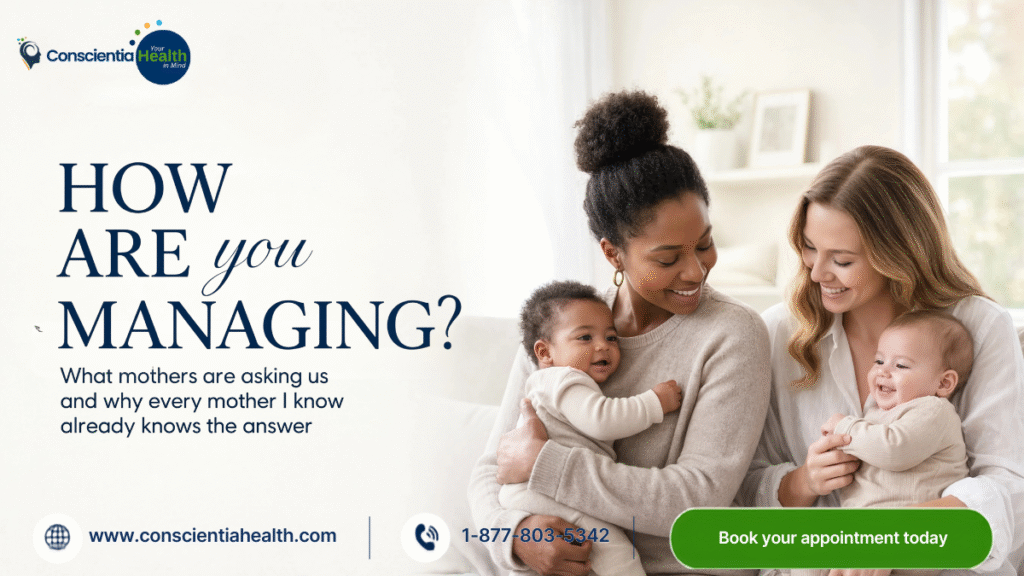
How are you managing?
Not “How are you doing?”
How are you managing?
Let Me Go First
I have four children.
Nineteen, sixteen, five, and a newborn.
I can say with complete confidence that children need their mothers at every stage of life.
The needs simply change shape.
Recently, I was taking my nineteen-year-old back to college.
I had work.
Responsibilities.
Meetings.
A company to run.
I hoped I could simply help coordinate the move remotely.
Instead, my son looked at me and said:
“No, Mom. Please. I need you.”
So I went.
I helped set up his room.
Those two days were beautiful.
But even during those beautiful moments, I was managing my business, supporting my family, caring for a newborn, checking on my five-year-old, and doing what mothers everywhere do every single day.
Juggling.
Always juggling.
The Mental Load No One Talks About
Motherhood is not a role you clock out of.
It’s not a shift that ends.
It’s a lifelong responsibility.
And for most mothers, it is carried alongside countless other responsibilities.
The reality is that many women genuinely love caring for their children.
And at the same time, many women are struggling beneath the weight of everything they’re carrying.
Both can be true.
We have to become comfortable saying those truths in the same breath.
This is where conversations about postpartum depression, postpartum anxiety, and maternal mental health become so important.
Because sometimes what we’ve accepted as “normal motherhood” may actually be a sign that more support is needed.
When Postpartum Depression and Anxiety Go Unnoticed
Did you know that postpartum depression doesn’t always look the way people expect?
Sometimes it looks like:
- Constant worry
- Irritability
- Snapping at loved ones
- Checking on the baby repeatedly throughout the night
- Feeling unable to relax
- Ongoing anxiety that never seems to switch off
Many women assume these experiences are simply part of motherhood.
Sometimes they are.
Sometimes they are signs that a mother needs support.
Recognizing concerns early can make a meaningful difference in recovery and long-term well-being.
The Six Weeks That Break Many Women
Imagine this.
You’re 31 years old.
You found the person you want to spend your life with.
You get married.
You have a baby.
You’re also building a career and trying to maintain your professional identity.
Then, after childbirth, you receive six to eight weeks of maternity leave if you’re fortunate.
You’re barely adjusting to life with a newborn when it’s time to return to work.
You place your baby in daycare and go back to your responsibilities.
But emotionally, part of you never leaves home.
You miss your baby.
You worry.
You push forward because you have bills to pay and responsibilities to meet.
Then, before you’ve fully processed what happened physically, emotionally, professionally, and personally, life moves on.
Maybe another pregnancy follows.
Maybe another season of caregiving begins.
And all the while, the world says:
Your mother did it.
Your grandmother did it.
You’ll do it too.
But that’s not the lesson we should be carrying forward.
The strength we inherited isn’t simply endurance.
It’s permission to ask for help.
What to Watch For
This is not about self-diagnosis.
It’s about knowing when to reach out.
Signs You Should Talk to a Mental Health Professional
- Sadness, emptiness, or numbness lasting more than two weeks
- Anxiety that never seems to switch off
- Persistent fear and worry
- Rage or irritability that feels disproportionate
- Difficulty sleeping even when the baby is asleep
- Feeling disconnected from your baby
- Feeling frightened by your own thoughts
- Intrusive thoughts that are becoming more frequent
- Feeling like your family would be better off without you
These are important warning signs and should never be ignored.
When Postpartum Psychosis Is an Emergency
While postpartum depression and postpartum anxiety are common and treatable, postpartum psychosis is a psychiatric emergency.
Seek immediate emergency care if a mother experiences:
Hallucinations
Delusions
Severe confusion
Loss of contact with reality
Feeling commanded to do something dangerous
Thoughts of harming herself or her child
Do not wait to see if symptoms improve overnight.
Emergency treatment is necessary.
Ask for Help. Then Ask Again.
If you seek help and something still doesn’t feel right, keep advocating for yourself.
You are allowed to say:
“I need this documented, and I need a referral to a perinatal mental health specialist.”
You are allowed to ask questions.
You are allowed to seek second opinions.
You are allowed to ask for more support.
So, How Are You Managing?
Not the version you post online.
The real one.
The one who cries in the bathroom with the fan running.
The one who checks the baby at 2 a.m. and stays awake until 4.
The one who loves their children deeply and still finds themselves wondering whether they’re doing enough.
You are enough.
But you were never meant to carry all of this alone.
The Inheritance We Should Pass On
Our mothers and grandmothers survived.
Many sacrificed quietly.
Many endured without support.
Many carried burdens they never had permission to discuss.
Their gift to us wasn’t merely endurance.
It was the opportunity to create something better.
The opportunity to ask for help.
The permission to sit in the therapist’s chair.
To accept treatment.
To allow support.
To pursue healing rather than simply survival.
Thriving is the standard we get to set.
How Conscientia Health Can Help
At Conscientia Health, we understand the unique challenges that can affect mothers before and after childbirth.
Our providers offer compassionate, evidence-based care for individuals experiencing:
- Postpartum Depression
- Postpartum Anxiety
- Women’s Mental Health Concerns
- Psychiatric Evaluations
- Medication Management
- Virtual Mental Health Appointments
Helpful Resources
- Depression Treatment
- Anxiety Treatment
- Mental Health Services in New Jersey
- Mental Health Services in New York
- Mental Health Services in Florida
- Mental Health Services in Texas
- Book an Appointment
If You Need Someone Right Now
National Maternal Mental Health Hotline
📞 Call or Text: 1-833-TLC-MAMA (1-833-852-6262)
Free, confidential, available 24/7, English and Spanish, with interpreters available in more than 60 languages.
988 Suicide & Crisis Lifeline
📞 Call or Text: 988
Postpartum Support International
📞 1-800-944-4773
Provides peer support groups and access to perinatal mental health specialists.
If you or someone you love is experiencing confusion, hallucinations, or delusions after childbirth, seek emergency medical care immediately.