
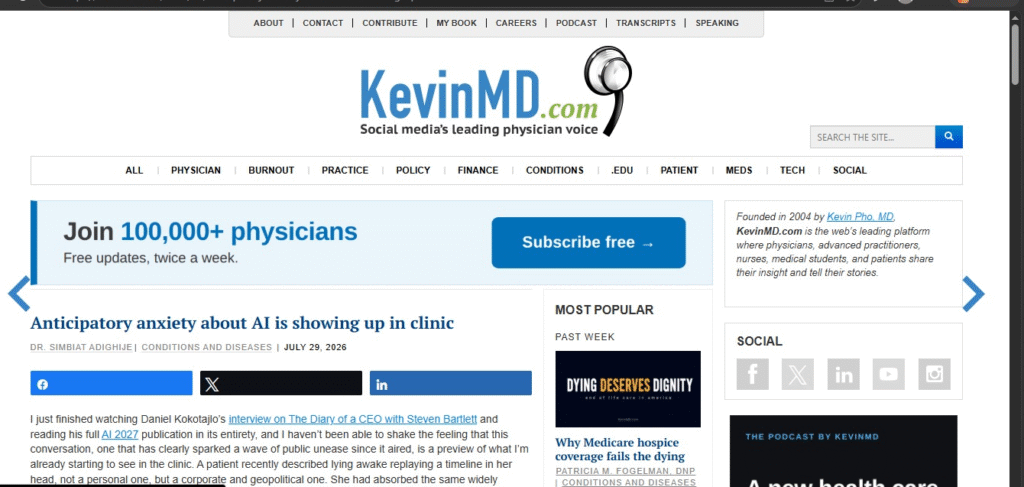
Editor’s Note
A version of this article was originally published on KevinMD.com and is republished here with additional context regarding the AiAA-5 (AI-Anticipatory Anxiety 5-Item Screen) developed by Conscientia Health.
Original publication:
https://kevinmd.com/2026/07/anticipatory-anxiety-about-ai-is-showing-up-in-clinic.html
Quick Answer
I just finished watching Daniel Kokotajlo’s interview on The Diary of a CEO with Steven Bartlett and reading his full AI 2027 publication in its entirety, and I haven’t been able to shake the feeling that this conversation, one that has clearly sparked a wave of public unease since it aired, is a preview of what I’m already starting to see in the clinic.
A patient recently described lying awake replaying a timeline in her head, not a personal one, but a corporate and geopolitical one. She had absorbed the same widely circulated forecast predicting that AI systems could begin automating most coding work by early 2027 and potentially trigger a broader “intelligence explosion” by the end of that year.
She wasn’t a software engineer.
She worked in logistics.
But she couldn’t stop checking the news, couldn’t stop imagining which parts of her job and her identity might be next.
I didn’t have a name for what she was experiencing. I still don’t, officially.
But after seeing versions of this presentation more than once in the clinic and since 2019 when a publisher patient first informed me about this “new technology coming called AI,” I think it’s time psychiatry gave it one:
AI-Anticipatory Anxiety.
While many people casually describe these concerns as AI anxiety, what I’m seeing clinically appears more specific. The worry isn’t simply about artificial intelligence. It’s often tied to detailed timelines, automation forecasts, and predictions about how rapidly society may change.
A New Stressor, an Old Pattern
Anticipatory anxiety isn’t new.
We see it in patients bracing for a medical diagnosis, a legal outcome, a natural disaster forecast.
What’s different here is the shape of the stressor itself.
This isn’t a diffuse, ambient worry about “the future of technology.”
It’s anxiety anchored to a specific, dated, highly detailed narrative, the kind popularized by scenario documents like AI 2027, which lay out month-by-month projections of AI capability, job automation, and geopolitical competition with unusual specificity.
That specificity is exactly what makes it psychologically potent.
Vague uncertainty is uncomfortable, but the human mind can often defer it.
A concrete date, a named year, a step-by-step scenario.
That’s harder to set aside.
It reads less like speculation and more like a countdown.
Unlike broader AI anxiety, which may reflect general concerns about technological change, many of these patients are describing distress tied to specific milestones and future forecasts.
What I’m Seeing Clinically
In practice, I’ve started to notice a cluster of features that distinguish this from generalized anxiety disorder or standard health anxiety.
Compulsive Engagement with AI-Risk Content
Patients describe doomscrolling AI news the way others describe doomscrolling around a health scare, unable to stop despite escalating distress.
Occupational Catastrophizing
Even patients in roles with low automation exposure report identity-level fear, as if proximity to any AI-adjacent industry marks them for displacement.
Sleep Disruption
Tied to specific headlines or forecasts rather than to general life stress.
A Felt Sense of Powerlessness
Patients often say some version of:
“There’s nothing I can do to prepare.”
This differs meaningfully from the future-focused problem-solving we usually try to elicit in anxiety treatment.
These presentations often go beyond ordinary workplace stress and resemble a distinct form of AI anxiety centered on future uncertainty, identity, and perceived loss of control.
None of this means the underlying forecasts are correct. That’s a debate for AI researchers, not psychiatric providers.
Clinically, however, that debate is almost beside the point.
The anxiety is real regardless of whether the forecast proves accurate, in the same way climate anxiety is a legitimate clinical presentation regardless of one’s views on specific emissions models.
Toward a Clinical Framework: The AiAA-5
As AI anxiety becomes more common in public discourse, clinicians may benefit from practical tools that help distinguish everyday concern from clinically significant distress.
I don’t think we need a new DSM entry.
I think we need a practical, brief screening approach clinicians can use now, borrowing structure from existing health-anxiety and eco-anxiety instruments.
I’m proposing a starting point:
The AiAA-5 (AI-Anticipatory Anxiety, 5-Item Screen)
Developed at Conscientia Health as a first-pass clinical framework, offered here for discussion and future validation rather than as an established instrument.
1. How often do you check news or content about AI developments?
2. Does that content consumption affect your sleep, mood, or concentration?
3. Do you feel a specific timeline (rather than general uncertainty) driving your worry?
4. Do you feel your occupation or identity is threatened, even if your role has low direct AI exposure?
5. Does the worry feel actionable, or do you feel unable to prepare regardless of what you do?
Proposed Scoring
Each item is rated 0 (“not at all”) to 3 (“nearly every day/very strongly”), for a possible total of 0 to 15, mirroring the response format of instruments like the GAD-7 and PHQ-9 for ease of clinical adoption.
A provisional cut point of 8 or higher, particularly when Questions 3 and 5 are individually elevated, may flag a presentation that benefits from targeted psychoeducation, media-consumption boundaries, and timeline literacy rather than standard anxiety-disorder treatment alone.
I want to be clear that these thresholds are a clinical starting hypothesis, not a validated cutoff. That determination requires the kind of psychometric study, including item analysis, test-retest reliability, and convergent validity against established tools, that I would encourage researchers to pursue alongside us.
Why This Matters Now
Mental health systems are already stretched.
If AI-driven societal change compresses into a shorter timeframe than prior technological shifts, as some forecasts suggest, psychiatry needs to be ahead of the curve, not reacting to it after a wave of patients arrives with a stressor we haven’t yet learned to name or measure.
This isn’t a call to validate every catastrophic prediction about AI.
It’s a call to take seriously what happens in the room when patients bring those predictions in with them.
Whether the future unfolds exactly as forecasted remains uncertain.
What is not uncertain is that AI anxiety is already appearing in clinical conversations.
As mental health professionals, understanding and addressing AI anxiety may become increasingly important as technology continues to evolve.
How Conscientia Health Can Help
If anxiety about technology, job security, uncertainty, or rapid societal change is affecting your daily life, support is available.
Conscientia Health provides:
- Anxiety Treatment → https://conscientiahealth.com/services/
- Psychiatric Evaluations → https://conscientiahealth.com/services/
- Medication Management → https://conscientiahealth.com/services/
- Mental Health Services in New Jersey → https://conscientiahealth.com/new-jersey/
- Mental Health Services in New York → https://conscientiahealth.com/new-york/
- Mental Health Services in Florida → https://conscientiahealth.com/florida/
- Mental Health Services in Texas → https://conscientiahealth.com/texas/
- Book an Appointment → https://conscientiahealth.com/bookings/
FAQ
What is AI anxiety?
AI anxiety refers to persistent worry about artificial intelligence, automation, job security, technological change, or future societal disruption.
Is AI anxiety a mental health diagnosis?
No. AI anxiety is not currently a recognized psychiatric diagnosis.
What is AI-Anticipatory Anxiety?
AI-Anticipatory Anxiety (AiAA) is a proposed term describing anxiety tied to detailed AI forecasts, timelines, and predictions about future technological change.
What is the AiAA-5?
The AiAA-5 is a proposed screening framework developed by Conscientia Health to support discussion and future research into AI-related anxiety presentations.
Can AI anxiety affect sleep?
Yes. Some individuals report difficulty sleeping, racing thoughts, and persistent worry after consuming AI-related forecasts, news coverage, or discussions about automation and job displacement.
About the Author
Dr. Simbiat Adighije, known to patients and colleagues as Dr. Sim, is a practicing Psychiatric Mental Health Nurse Practitioner and the Founder & CEO of Conscientia Health, a leading psychiatric and integrated care practice operating across all 50 U.S. states. Conscientia Health’s mission is to make mental health care as accessible and routine as an annual physical, treating the whole person, mind and body, under one roof. With more than sixteen years in clinical practice, Dr. Sim continues to see patients in person across Conscientia Health’s locations in New Jersey, New York, and California.
Dr. Sim is a member of the Forbes Business Council and has been featured in Forbes, USA Today, On Air With Mario Lopez, and PAPER Magazine for her work reshaping how mental health care is delivered and discussed. She reaches a combined online community across multiple social platforms, including a verified Instagram following of nearly 50,000, where she focuses on mental health and wellness education.
Her public commentary is anchored by the question at the center of her USA Today piece:
“What if mental health care were as routine as an annual physical?”
She frequently speaks on panels and at industry events about the future of mental health care, health technology, artificial intelligence, and integrated care models. Most recently, she joined a panel with Spotify at NY Tech Week 2026 discussing health care technology and AI innovation.
Dr. Sim began her career as a Registered Nurse before earning her bachelor’s and master’s degrees in nursing, summa cum laude, from Rutgers University in New Jersey. She later earned her MBBS, MD, and PhD in Public Health from the University of Science, Arts, and Technology (USAT) in Montserrat in 2014, graduating with multiple academic merit honors. Following the tragic loss of her mother, she chose not to pursue medical residency and has maintained American Nurses Credentialing Center (ANCC) board certification as a Psychiatric Mental Health Nurse Practitioner since 2010.